


Hitachi Construction Machinery’s Road to 2050
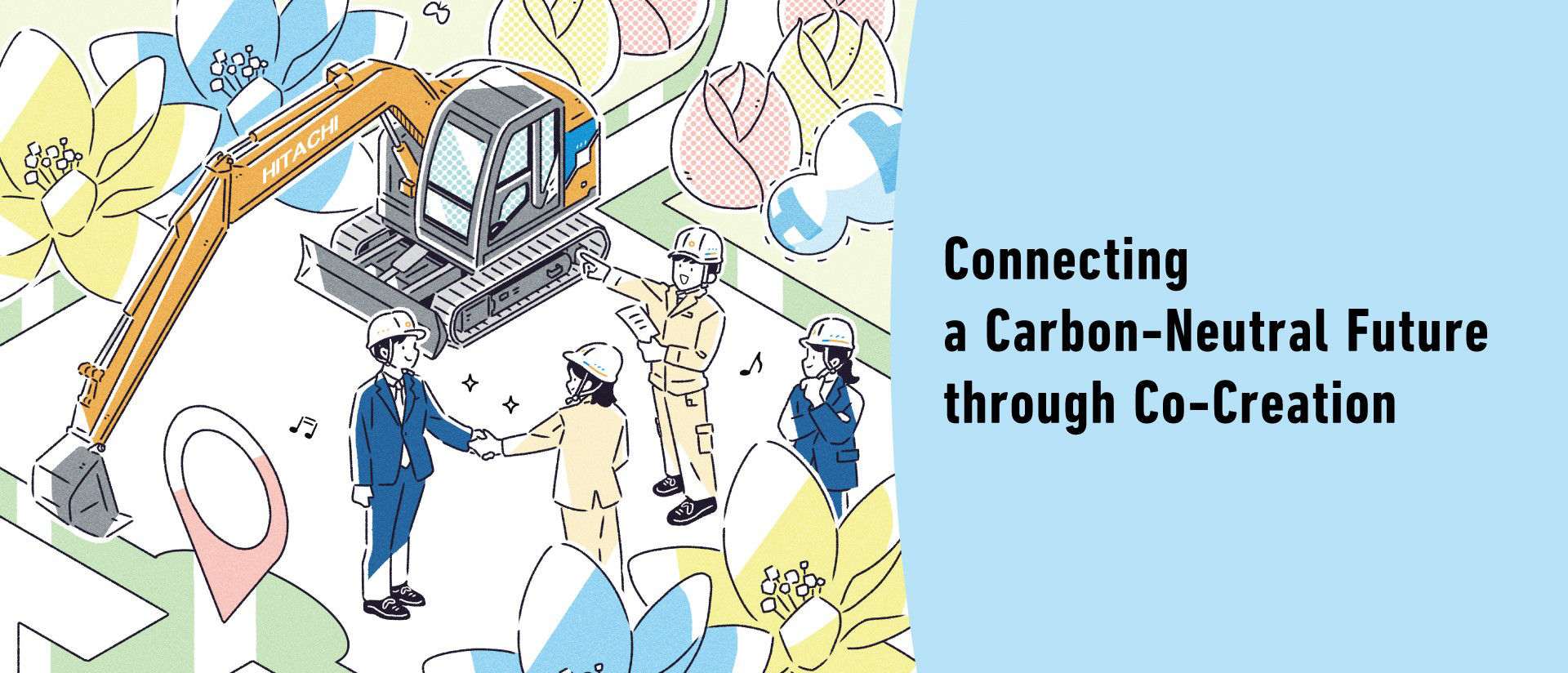
Hitachi Construction Machinery is committed to achieving carbon neutrality across its entire value chain by 2050.
One of its initiatives is the development of electric construction machinery, which is expected to reduce CO2 emissions on sites such as construction sites.
In October 2023, Hitachi Construction Machinery formed a project team to introduce electric construction machinery and promote its adoption. We spoke with the department manager, Katsuyoshi Hibi, about the project’s current status and his vision for the future.

Katsuyoshi Hibi
General Manager, Zero Emission Business Model Planning Project,
New Business Creation Unit
Director, ZERO EMISSION EV-LAB
Expanding the Adoption of Electric Construction Machinery through Open Innovation
Hitachi Construction Machinery is pursuing carbon neutrality in its product development and production processes. With regard to product development, we have set the goal to reduce CO2 emissions by 22% by FY2025 and 33% by FY2030, respectively, from FY2010 level.
To achieve this goal, the market introduction and widespread adoption of electric construction machinery will play a crucial role. Hitachi Construction Machinery has already developed and begun selling three battery-powered excavator models. The “Zero Emission Business Model Planning Project,” of which I am the department head, was created to actively promote the widespread adoption of these types of electric construction machinery. Although we refer to it as business model development, the themes we address are diverse. Our department is composed of members with varied backgrounds, including sales, quality assurance, production engineering, after-sales service, and digital transformation (DX). We also collaborate closely with other departments, including development, design, sales, and after-sales service.
There are several challenges to widespread adoption, one of which is usability. Differences in energy supply methods (fuel or electricity) and continuous operating times mean that operational aspects significantly impact customer usability. Developing charging infrastructure is a top priority among these aspects. For instance, battery-powered excavators may require charging equipment depending on the conditions of the site and the environment. In such cases, solutions are needed to manage optimal charging times to ensure sufficient operating hours.
Developing solutions and building business models in the new field of electric construction machinery is impossible without open co-creation with external partners. The research hub, ZERO EMISSION EV-LAB, which opened in May 2024, serves as a venue for interacting with these partners. Here, we can test actual equipment, such as electric construction machinery and charging equipment. Therefore, we can use this space to generate ideas both internally and externally.
Another major challenge to expanding adoption is economic rationality. Similar to electric vehicles, electric construction machinery faces a significant price gap with engine-powered machines due to the high cost of batteries. We are working to reduce not only product prices, but also costs across the entire product lifecycle, including operational aspects. Meanwhile, subsidy programs for the electrification of construction machinery promoted by the Ministry of the Environment, the Ministry of Land, Infrastructure, Transport and Tourism, and the Ministry of Economy, Trade and Industry provide significant support for customers considering electric construction machinery. These subsidies cover battery-powered excavators that have obtained the GX Construction Machinery certification, as well as the portable charging equipment purchased with these products. We plan to leverage this program to encourage wider adoption.
The development and widespread adoption of electric construction machinery is just one way to achieve carbon neutrality. Our customers have diverse needs and face various challenges. In addition to electric construction machinery, we will develop new technologies, including alternative fuels, hydrogen, and fuel cells. Moving forward, we will pursue carbon neutrality through multi-pathway and open approach.
Roadmap for the Development of Environmentally Friendly Products and Solutions
toward Carbon Neutrality by 2050
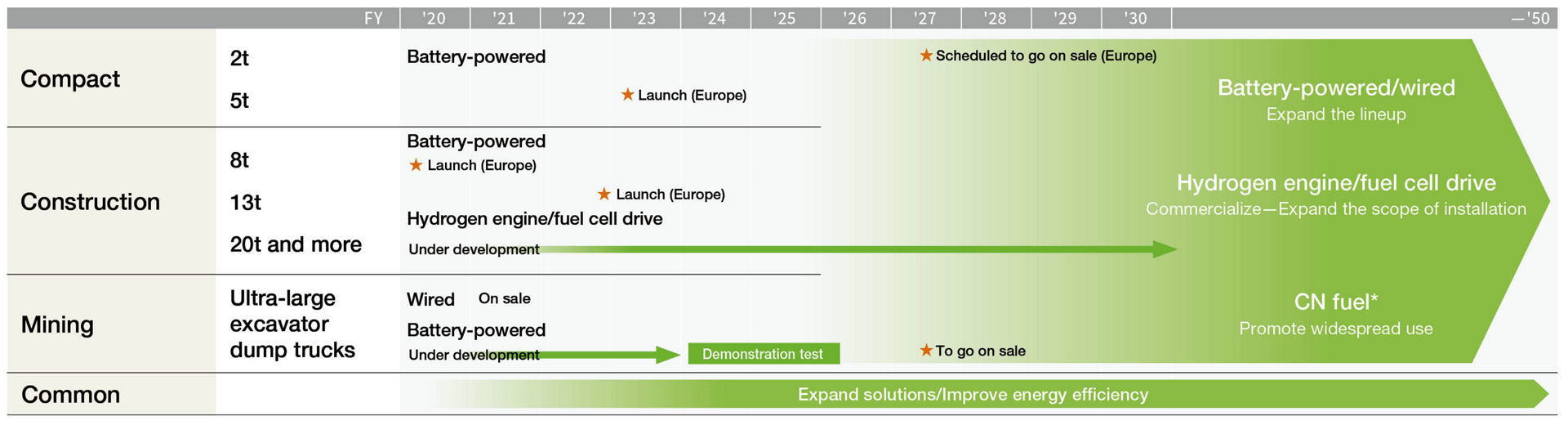
*CN fuel: Carbon neutral fuel (biofuel, e-fuel and other synthetic fuel)
Source: Hitachi Construction Machinery Group Integrated Report 2025
https://www.hitachicm.com/global/en/sustainability/download/
Text: Mutsumi Saito
Illustration: Keita Mizutani
Photos: Norio Sekine
 Embracing Challenges to Achieve Carbon Neutrality on Construction Sites
 LANDCROS Special Site

