


Embracing Challenges to Achieve Carbon Neutrality on Construction Sites
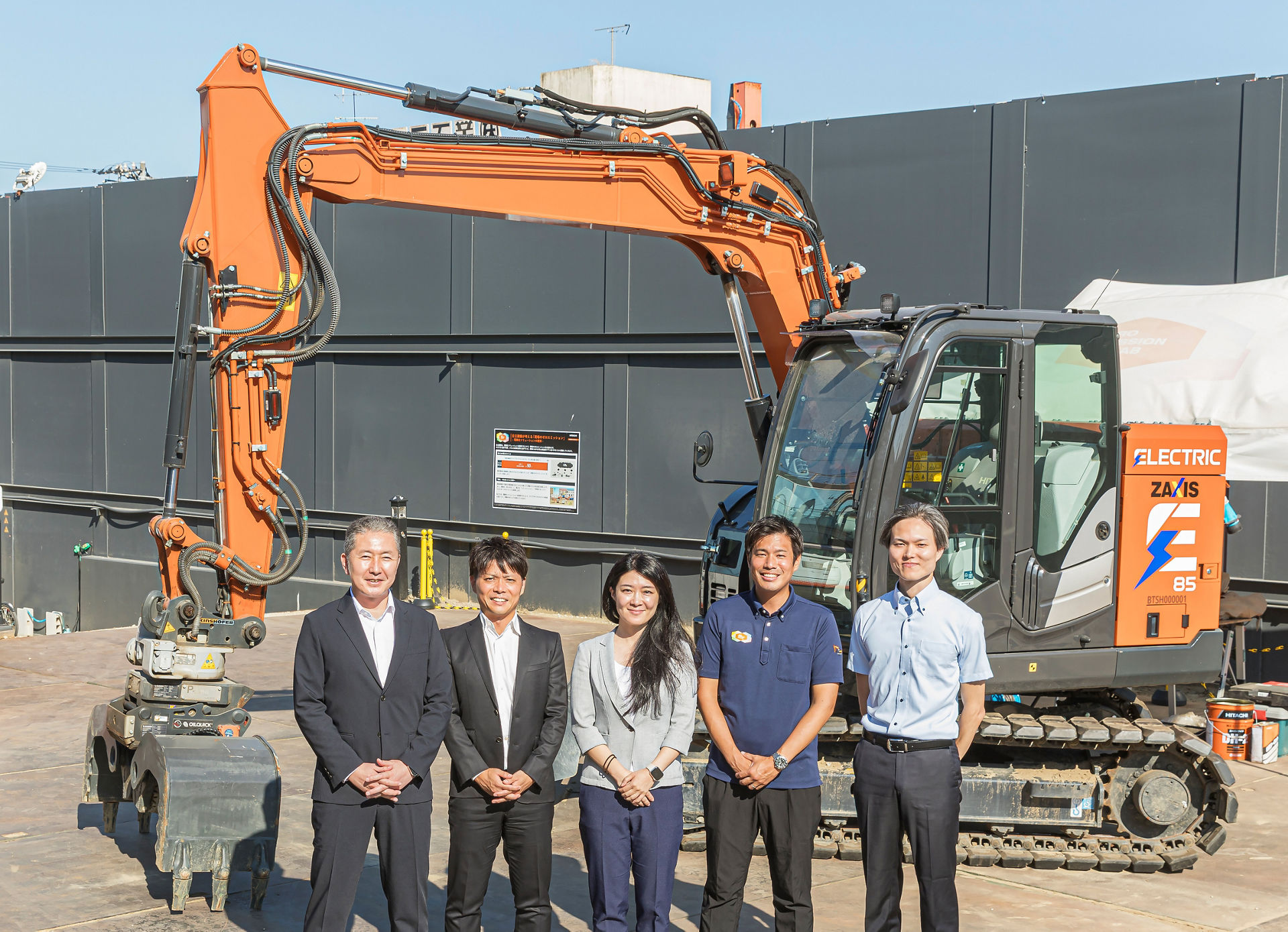
The “Zero Emission Business Model Planning Project ” promotes initiatives to achieve carbon neutrality at construction sites.
A cross-departmental working group (WG), supporting this project, is working to realize a sustainable society while facing issues on front line.
This time, we asked the WG members to share their mission and the challenges they face.


Hui Wang
Manager,
Zero Emission Business Model Planning Project,
New Business Creation Unit

Yoshihito Nishimura
Assistant Manager,
Zero Emission Business Model Planning Project,
New Business Creation Unit

Seigo Amino
General Manager, Technical Support Department,
Service Division,
Construction Business Unit

Shuhei Ueno
Manager,
Product Marketing Department,
Business Planning Division,
Construction Business Unit

Yuuki Makimura
Senior Engineer, Electric Products Development Department,
Development Division, Construction Business Unit
―What role does the WG play?
Wang: The WG promotes the adoption of electric construction machinery by identifying challenges and advancing activities to resolve them. Since the market environment differs significantly from that of conventional, engine-powered construction machinery, it is crucial to determine user requirements and the scenarios in which the machinery will be utilized. Insights from various departments, including marketing, design, sales, and after-sales service, are indispensable for these discussions. Therefore, the WG is structured as a cross-departmental team, enabling highly effective activities that reflect feedback from the field.
Ueno: Our company has been a pioneer in the electrification of construction machinery since developing our electric excavator in 1962. In 2020, we released the ZE85 battery-powered excavator to the European market. Since then, we have expanded our lineup to include models such as the ZX55U-6EB and ZE135. Through deploying these products, we have identified sites and environments where battery-powered excavators are particularly suitable, as well as trends in customer usage patterns. However, there are also cases in which electric construction machinery cannot fully meet requirements. Figuring out how to address such situations is a new challenge. The WG is developing an overall strategy to achieve carbon neutrality by considering not only electric construction machinery, but also alternatives such as light oil substitutes and hydrogen.



―Please tell us about your department and area of expertise, as well as the challenges you will tackle in the WG.
Ueno: I work in the Product Marketing Department and handle product planning for electric construction machinery. I believe that merely providing the machinery is insufficient for promoting the adoption of electric construction machinery. Through my work in product planning, I’ve come to believe that offering an integrated solution that includes the machinery, power source, and operation is essential to providing value to customers.
Makimura: I work in the Electric Products Development Department. I am responsible for selecting and developing batteries and electric components for battery-powered excavators. In developing electric construction machinery, I particularly feel the challenge of “economic rationality.” It is crucial not only to lower the unit price, but also to demonstrate operational patterns that allow customers to see the tangible benefits, including the total lifecycle cost of their operations. Proposals that are grounded in actual usage scenarios, rather than just technological development, are key to widespread adoption.
Nishimura: I belong to the Zero Emission Business Model Planning Project, where I have primarily handled sales. In my current role, I listen to customer feedback, propose solutions tailored to on-site conditions, and verify them. By closely addressing field challenges, I aim to build optimal solutions that facilitate smoother adoption of electric construction equipment.
Amino: I work in the Technical Support Department. Currently, I am establishing an after-sales support system for electric construction machinery. I also handle inquiries regarding alternative light oil fuels, such as biofuels and renewable diesel (RD). The basic structure of conventional engine-powered construction machinery has seen little change over many years. For this reason, we have skilled service staff in each region to ensure a comprehensive service system is in place. However, this is not the case for electric construction machinery. As more units are introduced, it will be crucial to gather operational data and repair case studies early on and share this know-how with field service staff to ensure they can provide the appropriate service. Because this technology is new, we must build the support system while maintaining close collaboration with the field.
Wang: Since joining the company, I have primarily been involved in overseas operations, including export activities for international markets. Currently, I am part of the Zero Emission Business Model Planning Project, in which I am responsible for creating a business model that will help us achieve carbon neutrality at construction sites. It is crucial that this initiative focuses not only on reducing environmental impact, but also on providing economic and managerial benefits to both our customers and our company. Our goal is to create value that balances environmental sustainability and economic viability, contributing to the realization of a sustainable society.
―What activities is the WG currently undertaking?
Nishimura: The most valuable aspect of this project for me is hearing our customers’ feedback. Many companies have set the goal of achieving carbon neutrality by 2050, but it’s not uncommon to hear concerns like, “We don’t know where to start.” There isn’t one method for reducing CO2 at construction sites. The optimal approach varies depending on the site environment and the work being done. That’s precisely why we strive to gather detailed information about site conditions from our customers, hold multifaceted discussions within this WG, and make the best possible proposal. We aim to support the realization of effective carbon neutrality while addressing our customers’ specific challenges.
Makimura: The direct feedback we receive from the field is extremely valuable for design. For battery-powered excavators, since operational data is still limited, customer feedback and input from sales representatives are beneficial and appreciated from a design perspective. I believe that our system, which enables us to incorporate field challenges and needs directly into our products, leads to the creation of more practical and reliable products.


Ueno: I am also actively seeking opportunities to visit customer sites and understand their needs. While we currently focus on electric construction machinery, some sites may be better suited for alternative fuels than for electric power. We are also exploring the potential of hydrogen. Achieving carbon neutrality requires proposing an optimal solution based on each site’s environment, work content, and the specific circumstances of each country.
Nishimura: Indeed, electricity supply conditions vary significantly by region. In countries like Norway, for example, where renewable energy sources like hydropower dominate, the environmental benefits of electric construction machinery are maximized, making it a highly compatible solution. Conversely, in regions that rely heavily on thermal power generation, non-electric options may sometimes be more suitable. In addition to reducing CO2, electric construction machinery offers significant advantages, such as zero exhaust emissions and lower noise levels. We have already begun a field demonstration of electric construction machinery and are steadily accumulating real-world operational data. Moving forward, we aim to identify and propose optimal solutions for each customer. This will involve combining these benefits with the efficiency gains of ICT construction solution and the digitization and visualization of construction sites.

―How will this WG and Hitachi Construction Machinery work together to achieve carbon neutrality?
Ueno: Around 2019, companies began introducing electric construction machinery to the market. However, challenges related to operating time and charging gradually became apparent. For instance, increasing battery capacity extends operating time but also raises the price. Depending on the site, using a smaller battery capacity and operating via a cable might be more suitable. Flexible product design is required to address these challenges, including offering options unique to electric construction machinery. At our company, establishing the ZERO EMISSION EV-LAB in 2024 allowed us to verify using actual machines and advance development more closely aligned with real-world site conditions.
Makimura: When designing electric construction machinery, selecting the right battery is critical, but keeping costs low remains a major challenge. We believe that designing batteries that can be used across multiple models is also necessary. We expect that these approaches will reduce costs, improve maintainability, and stabilize the supply.
Wang: In order to achieve carbon neutrality, we believe that our role is to identify which technologies will become mainstream and prepare to deliver the optimal solution to our customers, regardless of which technology emerges. We must establish a system capable of providing the best tailored solution to our customers’ needs.―That is the goal we must achieve within the next three years.
Amino: In terms of customer service, we have worked for decades to reduce downtime caused by machine breakdowns. This effort ultimately benefits the global environment. Reducing machine downtime eliminates the need to arrange for and transport replacement machines, thereby curbing excess fuel consumption and CO2 emissions. Additionally, the use of resources for part replacements and repairs is minimized. Stable machine operation improves work efficiency, reducing unnecessary idling and rework. All of these factors contribute to lowering environmental impact. Recently, electric construction machinery and alternative fuels for light oil have gained attention. However, it is crucial to quickly instill the understanding that the daily activities of each department contribute to reducing environmental impact. Cultivating a company-wide culture of environmental consideration will also provide value to our customers. Our goal is to make conversations about “what we can do for the environment” commonplace, not limiting them to electric construction machinery or alternative fuels for light oil. Through these daily efforts, we are working to achieve our environmental goal of realizing carbon neutrality across our entire value chain by 2050.

Co-creation with Customers
RD Fuel Field Demonstration Test ―Kajima Corporation

Kajima Corporation conducted a demonstration test of a next-generation fuel at a highway tunnel construction site in Yokohama City using a hydraulic excavator provided by Hitachi Construction Machinery. The fuel used in the demonstration is called “RD (Renewable Diesel),” which is a liquid fuel refined through hydrogenation processing using waste cooking oil and other materials as feedstock. Hitachi Construction Machinery plans to use the results of this demonstration for future CO2 reduction measures.
Co-creation with Partners
Hydrogen Generator Demonstration ―Hitachi Energy

Hitachi Energy introduced its “HyFlex” hydrogen generator to the Netherlands for the first time. During a demonstration in Rotterdam, the generator supplied power to Hitachi Construction Machinery’s ZE135 battery-powered excavator, proving the feasibility of zero-emission construction sites. Through cross-industry collaboration, we are providing clean energy solutions that replace diesel and advancing the decarbonization of construction sites.
 Hitachi Construction Machinery’s Road to 2050
 LANDCROS Special Site

